Standing and Perch Stairlifts: Who They Suit, UK Prices and the Safety Checklist
Most people assume a stairlift means a seat — but for a meaningful group of users, sitting is exactly the problem. Arthritic knees, hip or knee replacements and age-related stiffness can make the sit-down-stand-up cycle the most painful part of the journey. The standing (or "perch") stairlift exists for precisely this case — and as a bonus, it squeezes into staircases where no seat would fit.
In short: Standing and perch stairlifts cost roughly £1,895–£7,000 in the UK — straight models from around £2,000, curved perch designs from about £4,950. They suit people who find bending painful but can stand steadily — and they fit staircases as narrow as about 60cm, where seated lifts struggle.
How a standing lift differs from a perch
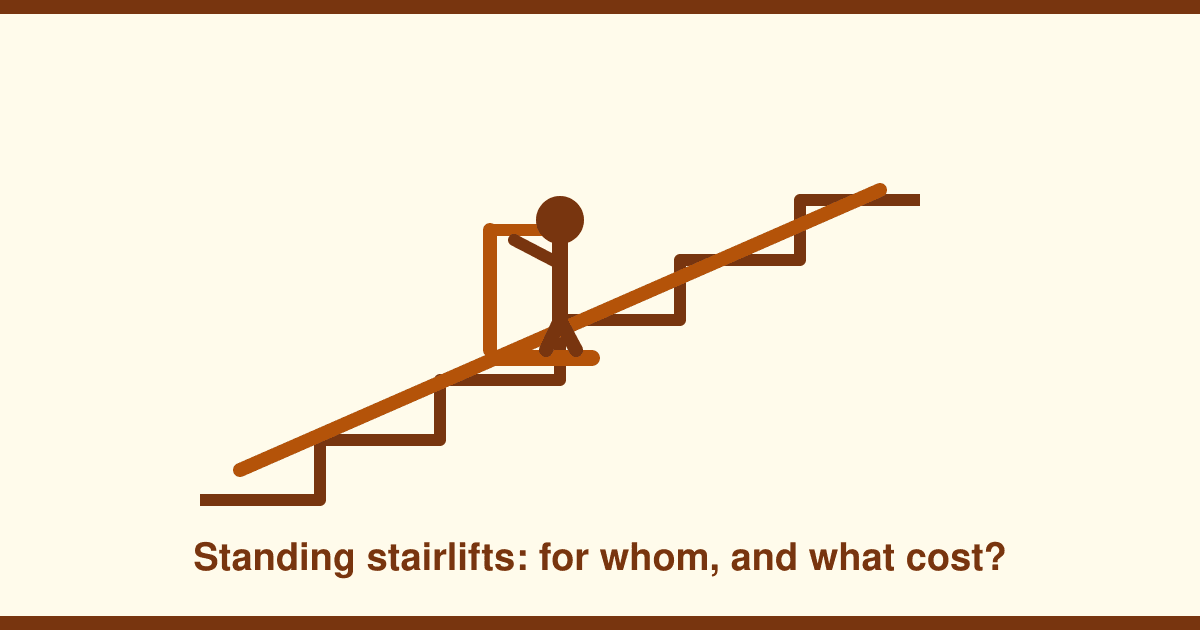
The two terms travel together but aren't identical. A standing stairlift carries you fully upright on a platform with grab rails. A perch stairlift adds a narrow, raised ledge to lean against — half sitting, half standing — taking some weight off the legs without demanding a full knee bend. In practice, most "standing" installations are perch designs, because the ledge adds security for minimal extra depth.
Who genuinely benefits
- Painful knees and hips: Arthritis, joint replacements and stiffness that make a low seat an ordeal — the core use case.
- Narrow staircases: From roughly 60cm width, a perch lift fits where a seated lift won't — often the deciding factor in older terraced houses.
- Tall users: Very tall passengers who find standard seats cramped often find perching more comfortable on short journeys.
Who should think twice
The honest limitation: a standing lift trades leg comfort for balance demands. You ride upright, so you need steady balance and the ability to stand for the journey's duration — dizziness, blackouts, severe weakness or conditions affecting stability point firmly back to a seated lift, where the standard types comparison is the better starting point. Headroom matters too: standing raises your height on the stairs, so low ceilings and sloped landings need measuring, not guessing.
What they cost
| Model | Typical UK price |
|---|---|
| Straight standing/perch lift | from around £2,000 (range £1,895+) |
| Curved perch lift (custom rail) | from around £4,950 |
| Overall range including installation | £1,895 – £7,000 |
The pricing logic mirrors seated lifts: the rail drives the cost, so straight flights are cheap and curved custom rails are not. The same funding routes apply too — grants and funding help and renting instead of buying both work for perch models, and reconditioned units appear on the market as well (what to check before buying used).
The two assessments that settle it
- A home assessment by the installer — mandatory anyway, but for perch lifts it must confirm stair width, headroom along the full flight, and safe boarding space at top and bottom.
- A word with your GP or physio — the balance question is medical, not technical. Suppliers sell lifts; clinicians know whether standing for ninety seconds on a moving platform is safe for you. Five minutes here prevents an expensive mistake in either direction.
Safety spec to insist on: grab rails on both sides, a fold-down safety bar or harness, gentle start/stop, and — as with any stairlift — battery operation that finishes the journey in a power cut. A reputable installer includes all of this without being asked; treat its absence as a warning sign.
The bottom line
For painful knees on a narrow staircase, a perch stairlift is often the only solution that actually solves both problems — at £1,895–£7,000 depending on the rail. Let the medical question lead the purchase: if balance is sound, perch confidently; if it isn't, a seated lift serves better. Compare vetted stairlift suppliers and installers near you here.
Frequently asked questions
A stairlift where you ride in a half-standing position, leaning against a narrow raised ledge with grab rails, instead of sitting. It suits people who find bending their knees painful — due to arthritis, joint replacements or stiffness — and takes up less depth than a seated lift.
Between roughly £1,895 and £7,000 installed: straight perch and standing models start around £2,000, while curved designs with custom rails begin at about £4,950. As with seated lifts, the rail shape drives the price far more than the carriage.
For the right user, yes — with grab rails, a safety bar or harness, gentle start/stop and battery backup as standard. They do require steady balance and the ability to stand throughout the ride, so dizziness or significant weakness points to a seated lift instead. A GP or physio opinion plus the installer’s home assessment settles suitability.
Perch stairlifts fit staircases from roughly 60cm wide — significantly narrower than most seated models need. The installer’s home assessment confirms width, headroom along the flight and safe boarding space at both ends before anything is ordered.