Straight, curved or outdoor: choosing the right stairlift
The starting point for choosing a stairlift is almost always your staircase itself, not a preference between brands or features. The shape of your stairs determines which category of stairlift you need, and that decision then shapes cost, lead time and installation complexity, so it is worth understanding the differences clearly before you start getting quotes.
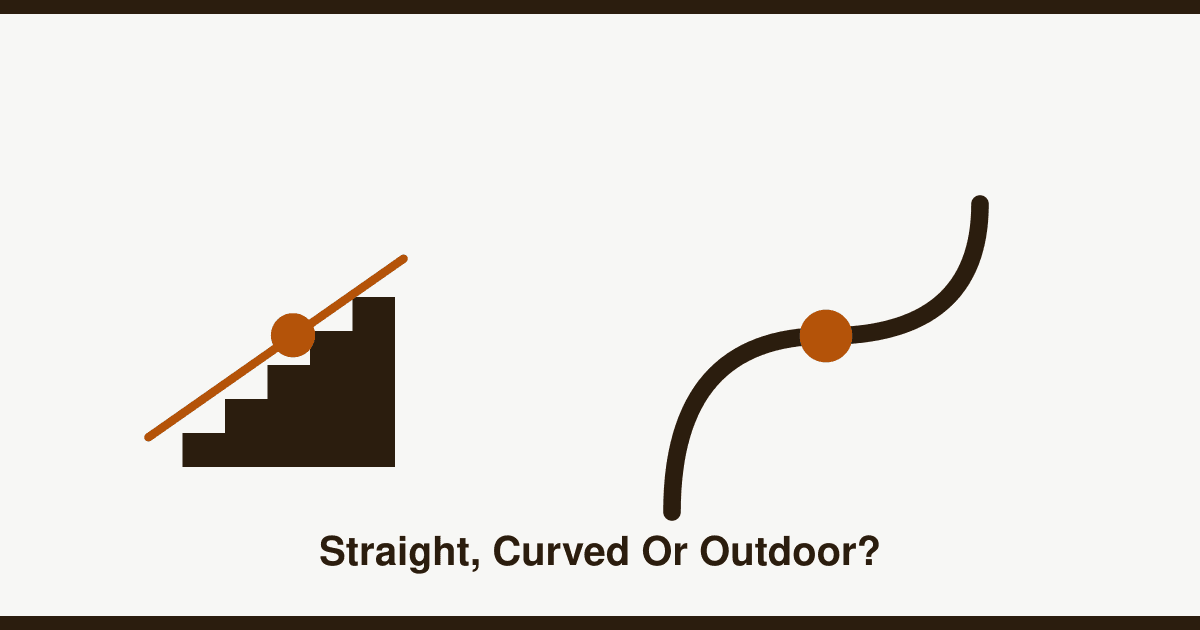
A straight stairlift is designed for a staircase that runs in one continuous, unbroken line, with no bends, turns or landings partway up. This is the simplest type of installation: the rail comes in standard lengths that an installer measures and cuts to fit your specific staircase on the day of fitting, rather than being custom-manufactured in advance. Because of this, straight stairlifts are generally the most affordable option and can often be surveyed and installed within days rather than weeks.
A curved stairlift is needed wherever a staircase has any kind of bend — a dog-leg turn, a half-landing, a spiral section, or simply an awkward change of angle partway up. Because no two curved staircases are quite the same shape, the rail cannot be a standard off-the-shelf part. Instead, an installer surveys your staircase in detail, often using laser measurement to capture its exact profile, and the rail is then manufactured specifically to match those measurements. This bespoke process is why curved stairlifts cost more and take longer to arrange than straight ones, typically three to six weeks between survey and fitting rather than a near-immediate turnaround.
Outdoor stairlifts are a distinct category worth knowing about if you need to get safely between levels outside — down to a garden, up to a garden building, or along external steps to a front door. These are built with weatherproofing that an indoor model does not have: sealed, weather-resistant electronics, materials rated to withstand rain and temperature swings, and often a cover for the seat when it is not in use. Because of this additional engineering, outdoor stairlifts generally cost more than an equivalent indoor straight or curved model, and it is worth being specific with an installer about whether a lift will be used outdoors so they quote the right product rather than an indoor model that will not hold up to the weather.
Staircase width is one of the first practical things a surveyor checks, since a stairlift rail and folded seat take up some of the width of the stairs even when not in use, and there needs to be enough clear space left for others in the household to use the stairs safely alongside it. Very narrow staircases can sometimes limit which specific models will fit comfortably, which is exactly the kind of detail a proper home survey is designed to catch — it is not something you need to work out yourself in advance, but it is worth mentioning to an installer if you already know your staircase is on the narrow side.
Weight capacity is another practical consideration, though it is worth treating any figures you see as general guidance rather than a fixed rule, since capacity varies by model and by the angle of your particular staircase. Standard stairlifts commonly accommodate users up to somewhere in the region of 120 to 160kg (roughly 19 to 25 stone), which covers the large majority of adult users. For anyone above that range, heavier-duty stairlift models exist with meaningfully higher weight capacities, and a good installer will ask about this directly during the survey rather than leaving you to guess which model is suitable.
The survey itself is generally free and without obligation, and it is worth thinking of it as the real decision-making step rather than a formality before a sale. A surveyor will measure your staircase precisely (using laser measurement for curved stairs), check the structural points where the rail will need to be fixed to the stairs or wall, ask about how you currently manage the stairs and any specific mobility needs — including whether you need a swivel seat to disembark safely, a folding rail section to keep a hallway clear, or particular seat height and armrest features — and talk through indoor versus outdoor requirements if relevant. They should leave you with a clear, itemised quote rather than a single headline figure, so you can see exactly what you are paying for.
If your mobility needs are more complex — for example, if transferring in and out of a seated position is difficult, or if a family member uses a wheelchair for part of their journey up and down — it is worth arranging an occupational therapist assessment either before or alongside the stairlift survey. An occupational therapist can look at your specific movement, balance and transfer ability and advise on what kind of adaptation, seat type or additional support will actually work safely for you day to day, which is a different and complementary kind of expertise to a stairlift installer's technical survey of your staircase.
This article is general information, not medical advice, and the right stairlift for your home depends on your own staircase and your own needs. Our directory lists UK stairlift providers by area if you are ready to arrange a home survey and compare options.
Frequently asked questions
A straight stairlift is fitted to a staircase with no bends, using a standard rail cut to length on the day of installation. A curved stairlift is needed for any staircase with turns, half-landings or bends, and its rail is custom-manufactured to match the exact shape of your stairs following a detailed survey, which makes it more expensive and slower to arrange.
Yes. Outdoor stairlifts are built with weatherproof electronics and materials rated to withstand rain and temperature changes, which an indoor model does not have. If you need a lift for external steps or a garden staircase, tell your installer so they quote an outdoor-rated model.
Standard stairlifts commonly support users up to roughly 120-160kg (around 19-25 stone), though this varies by model and staircase angle. Heavier-duty models with higher weight capacities are available, and a surveyor will help identify the right one for your needs.
A surveyor measures your staircase (using laser measurement for curved stairs), checks fixing points, asks about your mobility needs and any features you require, and provides an itemised quote. It is normally free and without obligation, and is the best point to raise any specific concerns, such as a narrow staircase or complex mobility needs.